Do Not Copy the Million-Subscriber Channel
Someone told me this early on, and I thought it was backwards: study the biggest channel in your space, but model the small one.
If you are going to learn from anybody, surely you learn from the best? It took a few years of building faceless channels – and a lot of time spent taking other people’s channels apart – before I understood why it is one of the most useful pieces of advice a beginner can get.
What almost everyone does first
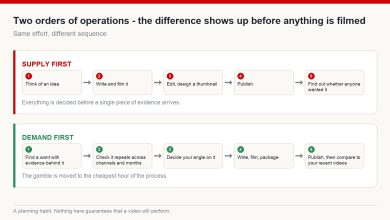
You decide on a subject. You search it. You find the channel with the most subscribers, and you start taking notes on everything: the thumbnail style, the way the titles are built, the edit, the pacing, the way the story is told.
Then you make five videos in that style and none of them do anything, and the obvious conclusion is that you executed it badly.
Usually you did not. You copied the visible part of a system whose invisible part is doing most of the work.
Why a large channel is a bad production model
A big channel is not just better videos. It has a name people recognise, which changes the click decision before the thumbnail is even assessed. It has a subscriber base large enough that a new upload gets shown to a meaningful audience on day one, which is how it gets the early signal that decides everything afterwards. It often has an editor, a designer, someone doing research, and the budget to try a dozen ideas a month and quietly discard most of them. It has an archive that keeps pulling people in while the new video finds its feet.
You may have a laptop, a subject you are interested in, and evenings.
Copy their title formula onto a channel with no audience and it goes to nobody. Not because the formula is bad, but because half of what made it work was never in the title.
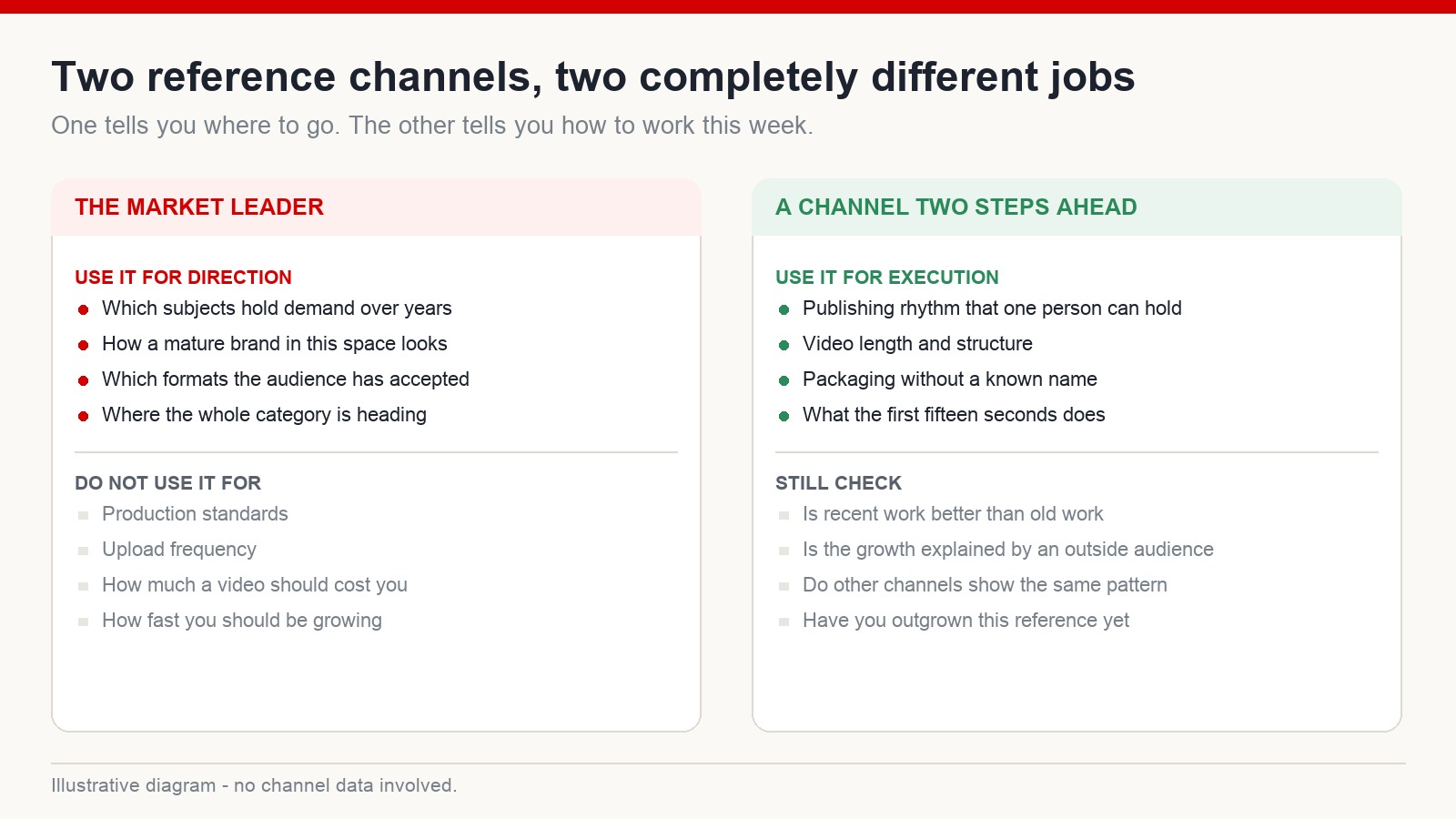
Direction from the leaders, execution from your peers
The split I use is simple enough to keep in your head.
Large channels answer strategic questions. Which subjects hold demand over years rather than weeks? What does a mature brand in this space look like? Which formats does the audience accept, and which have they clearly rejected? Where is the whole category heading? That is genuinely valuable, and it is the only place you can see it.
Channels near your own size answer operational ones. How often do they publish? How long are the videos? How do they package without a recognisable name to lean on? What does the opening do in the first fifteen seconds? Those answers you can act on this week.
The small-channel outlier signal
Inside that second group there is one thing worth more than everything else, and it is why small channels are so valuable to study.
Find a channel somewhere between roughly ten and a hundred thousand subscribers that has grown noticeably in the last few months. Look at its videos and find the one that sits far above the channel’s own median. That gap is the small-channel outlier signal.
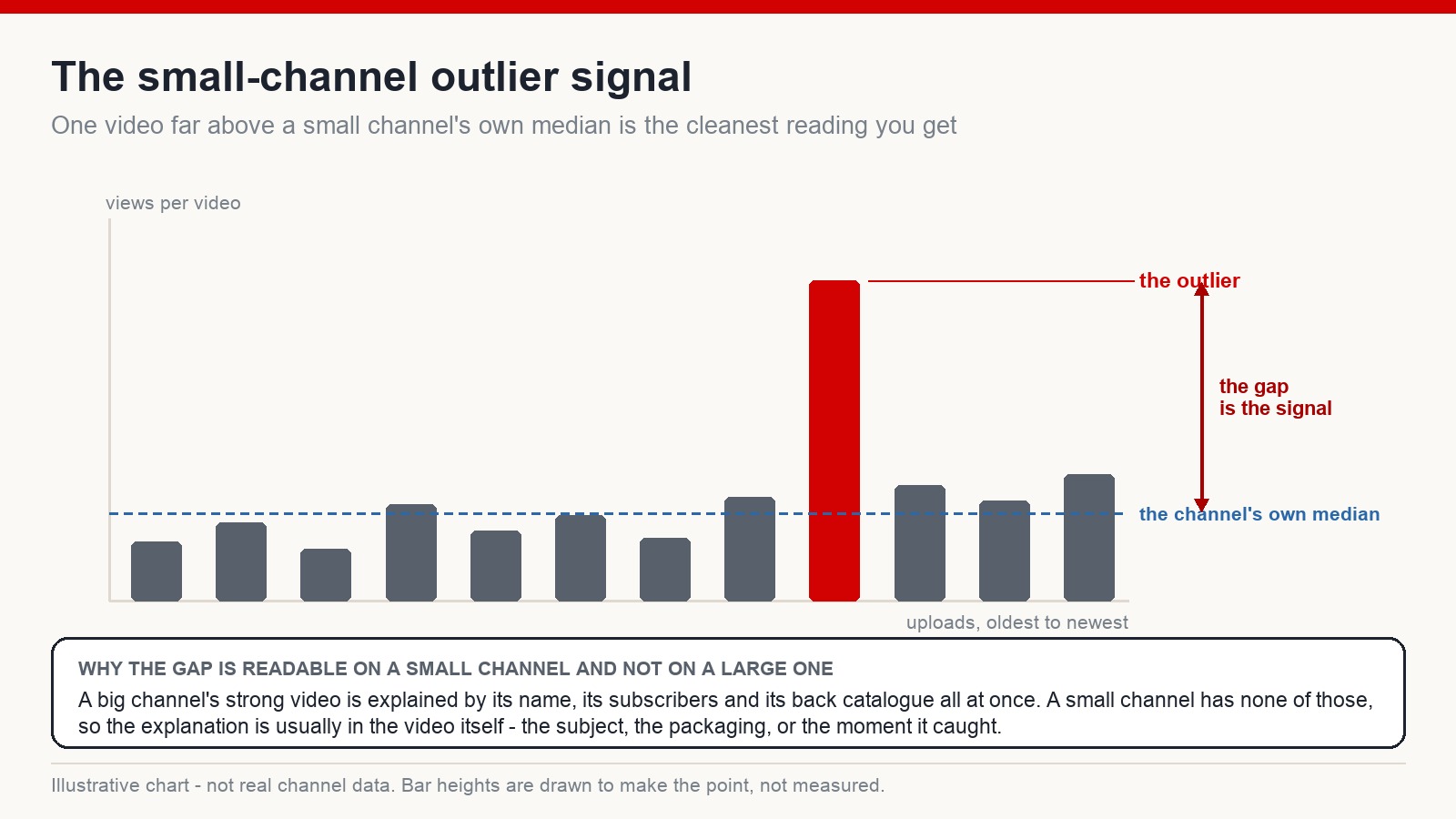
It matters because of what it cannot be. On a huge channel, a strong video is confounded – the subscriber base, the brand and the recommendation history all contribute, and you cannot separate them. On a small channel, none of that is available. If one video massively outperforms its neighbours, the explanation is almost always in the video itself: the subject, the packaging, or the moment it caught.
That makes it about as close to a clean reading as this work gets. And unlike a viral moment on a giant channel, it is a result produced under conditions similar to yours.
How to find those channels
Search your subject, then sort by upload date rather than relevance so the established players do not fill the page. You are scanning for two things: videos whose view counts look out of proportion to the size of the channel that made them, and channels whose upload history only goes back a few months.
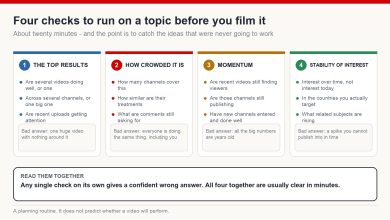
When one turns up, check three things before you take it seriously. Does its recent work outperform its older work, or is it living off one hit? Is the growth explained by something you cannot copy – an existing following elsewhere, a licensing arrangement, an off-platform audience? And can you find two or three other channels showing the same pattern, which turns one channel’s luck into a trend worth acting on?
What to take from a channel you are modelling
Once you have one, treat it as a reference rather than a template. The questions worth answering, in writing:
How often do they publish, and has that changed as they grew? How long is a typical video, and how long is their best one? What does the opening do before the first cut? What is consistent across their thumbnails – not the specific images, the conventions? Do they run series, and do numbered episodes perform differently from standalone ones? And the important one: which video broke first, and what was different about that one?
The last question usually reveals the pivot – the point where they stopped making what they had been making and started making what worked.
The obvious analogy
Nobody starting at the gym follows a professional athlete’s training programme. Nobody new to running trains at the pace of someone preparing for a competitive marathon. Not because those programmes are wrong, but because they assume a body that has already done years of preparation.
The same logic applies here. A production standard set by a team of six with a budget is not a standard a single person should hold themselves to in month two. It is a way of feeling like a failure while doing perfectly reasonable work.
Find someone a few steps ahead instead. They are the most practical teacher you will get, because everything they are doing is still within reach.
Four ways this goes wrong
Copying the assets instead of the reasoning. Taking a script, footage or a thumbnail is both against the rules and pointless – a copy has no reason to exist next to the original. Take the structure and the thinking.
Reading one channel and calling it a pattern. A single growing channel might be an anomaly. Two or three doing the same thing is a signal.
Missing the invisible advantage. Some channels grow on the back of an audience built somewhere else entirely, and no amount of copying the videos will reproduce it.
Keeping the same model channel forever. A reference chosen when you had nothing stops being useful once you have an audience of your own. Re-pick every few months.
What you are actually building
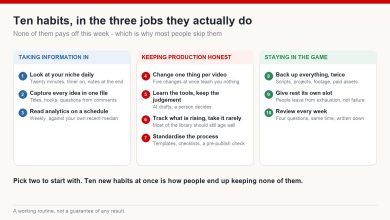
Having a channel to model does not make you derivative. It removes guesswork from the decisions that do not deserve creative energy – upload rhythm, video length, packaging conventions – so that your attention goes to the part that has to be yours.
Ideas overlap. Formats overlap. The execution is where a channel becomes recognisable, and nothing about following a reference stops that from happening.
Then, if you keep going long enough, the thing that happens is quietly satisfying: someone starting out this month opens a spreadsheet, searches your subject, and writes your channel down as the one they are going to model.
Frequently asked questions
Should I ignore big channels completely?
No. Use them for direction – which subjects carry lasting demand, how the category behaves, what a mature brand looks like. Just do not use them as a production standard while you are working alone.
Why are channels with ten to a hundred thousand subscribers so useful?
Because they are close enough to your circumstances to be copyable, and small enough that their results are not explained by an existing audience. What worked for them worked because of the video.
How do I find a channel worth modelling?
Search your subject sorted by recent uploads, look for videos that outperform the size of the channel behind them, then check that the channel’s recent work is still improving and that its growth is not coming from somewhere you cannot replicate.
Is it copying to follow another channel’s format?
Formats are not owned, and every niche has conventions. Copying is taking the actual work – script, footage, artwork. Learning the shape of a format and filling it with your own material is how most creators start.
How often should I change the channel I am modelling?
Every few months, or whenever you have clearly outgrown the questions it answered. The right reference is always slightly ahead of you, not permanently ahead of you.
If you want the whole framework this sits inside – research, packaging and production for an English-speaking audience – that is what I teach at mmoyoutube.com. Every channel is different, and none of this guarantees a particular outcome.